GeekyAnts Launches AI Readiness Calculator to Help Enterprises Identify Adoption Gaps
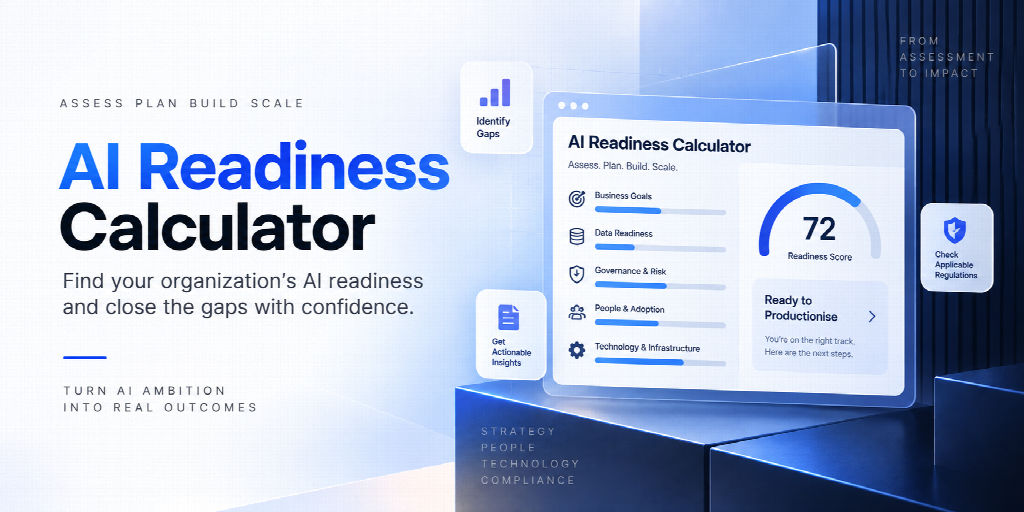
September 30, 2026 — GeekyAnts, an AI-powered digital product engineering and consulting company, has launched an AI Readiness Calculator to help organizations assess whether they are prepared to build, deploy, and scale AI.
The online assessment examines 10 dimensions of organizational readiness and places participants in one of four stages, ranging from Not Ready to Build to Potentially Ready to Scale. A companion compliance check also screens for regulations that may apply to a product and suggests engineering requirements for further review.
The launch comes as enterprise AI adoption continues to rise without delivering consistent financial returns. According to McKinsey's 2026 State of AI survey, nearly nine in ten respondents report regular AI use in at least one business function, while only 37% say AI has contributed positively to their organization's EBIT.
Gartner's September 2026 forecast estimates worldwide AI spending at $2.7 trillion in 2026, a 49.5% year-over-year increase. That figure includes significant infrastructure spending and should not be interpreted as enterprise spending alone. Gartner has also highlighted the need for organizations to achieve more predictable returns before AI can scale sustainably.
The AI Readiness Calculator focuses on the decisions behind this gap. Building a prototype is only one part of AI adoption. Organizations must also consider secure deployment, employee adoption, workflow changes, governance, and how business value will be measured.
"AI-led transformation creates value when enterprises connect intelligence with secure systems, product workflows, and people who own outcomes," said Kumar Pratik, Founder and CEO of GeekyAnts, in a company statement earlier this year.
How the AI Readiness Assessment Works
The assessment contains 24 questions and is designed to take approximately five to seven minutes. Participants receive an initial verdict after the first 10 questions, while a more detailed readiness report is available as a PDF by email.
The assessment evaluates 10 dimensions:
Business problem and desired outcome
Ownership and decision rights
Current workflow and AI suitability
Baseline and value measurement
Data and knowledge readiness
Human oversight, governance, and risk
Prototype success and production readiness
Workforce and change readiness
Production operating model
Scale readiness
Participants are encouraged to answer "Yes" only when supporting evidence exists rather than relying on confidence or intent. Because responses are self-reported, the assessment is intended as a starting point for internal discussion rather than an independent certification of AI readiness.
Based on the responses, organizations are placed into one of four stages: Not Ready to Build, Ready to Prototype, Ready to Productionise, or Potentially Ready to Scale.
The framework also includes three mandatory gates between stages. This means a strong overall score does not automatically qualify an organization for the next stage if critical requirements remain unresolved.
GeekyAnts separately publishes a 50-Point Production Readiness Checklist for AI-Generated Products, which focuses on engineering checks required before moving AI-generated prototypes into production. That checklist is separate from the 24-question readiness assessment.
How the Compliance Check Works
The companion compliance check gathers information across five areas to identify regulations and engineering controls that may require further investigation.
Its results are intended to support discussions between engineering, legal, security, and compliance teams. The questionnaire does not independently determine an organization's legal obligations.
Industry and Region
Users can select industries including fintech, healthcare, and manufacturing. Products operating across multiple sectors can be screened against requirements associated with more than one industry.
Regions include the US, EU-UK, India, Australia, Singapore-APAC, and Americas-ME. These options provide an initial screen, while relevant countries, states, activities, and affected users still require separate review.
Organization Profile
The assessment asks about:
Approximate annual revenue
Number of records or users processed annually
Potential critical infrastructure status
Whether the product is new or already operating
Threshold-based questions and uncertain answers are flagged for confirmation rather than automatically treated as established facts.
Product Capabilities
The tool also considers product functionality that may affect regulatory requirements, including:
Payment processing or holding customer funds
AI or machine learning used in decisions involving people
Third-party vendors with access to data
Cross-border data movement
Patient or clinical information
Medical devices
Marketing, profiling, or targeted advertising
For example, whether PCI DSS requires further review depends on factors such as payment processing responsibilities, cardholder data handling, and whether systems or providers can affect the security of that data.
Data Sensitivity and Deployment
Users identify the types of information processed, including personal data, financial records, health information, cardholder data, biometric information, children's data, and industrial telemetry.
They also select a deployment model such as multi-tenant cloud, dedicated cloud, on premises, or hybrid and edge infrastructure.
Additional questions cover cross-border transfers and the use of sub-processors or downstream vendors handling regulated information.
Turning Compliance Findings Into Engineering Work
The compliance results begin with a summary showing:
Regulations flagged for further review
Suggested critical-priority requirements
Requirements classified by the tool as mandatory
Items placed on a watch list
Each suggested requirement identifies its source rule and receives a priority classification.
For a new product, the findings can help teams identify work that may need to be included in architecture and delivery planning. For an existing system, the same output can be used as an initial gap-assessment checklist.
The tool also groups recurring technical controls into a shared foundation section. These may include:
Encryption in transit, including TLS 1.2 or later where appropriate
Encryption or tokenization at rest
MFA, RBAC, and least-privilege access
Tamper-resistant audit logging
Breach detection and notification processes
Retention and purge automation
Network segmentation
Consent and lawful-basis management
Continuous control monitoring
A single technical control may support several regulatory requirements, but teams must still confirm the appropriate scope, implementation, and supporting evidence for each obligation.
Suggested work is also grouped by engineering layer, including frontend, backend, authentication, integration and DevOps, database, network and communication, and storage.
For example, where consent is required, a frontend requirement could include presenting a clear consent request separately from the terms of service.
The tool additionally maintains a watch list of obligations that may become relevant as a product, market, business model, or regulatory environment changes.
Organizations can optionally request a walkthrough with GeekyAnts to discuss the assessment findings. Compliance results are displayed on screen without requiring a consultation request, while the full AI readiness report is delivered separately by email.
Together, the AI readiness assessment and compliance check provide organizations with a structured way to examine whether their AI plans are supported by the necessary business ownership, data, workflows, engineering practices, governance, and operating model.
Teams are still expected to validate their responses, confirm which regulations apply, and determine the engineering work required before treating any identified gap as resolved.
About GeekyAnts
GeekyAnts is an AI-powered digital product engineering and consulting company. Since 2006, the company has delivered more than 800 projects for over 550 clients across healthcare, BFSI, retail, logistics, education, and enterprise technology.
Its services include AI consulting and transformation, AI-powered product engineering, enterprise system modernization, and digital customer experience. Its engineering teams work across generative AI applications, AI copilots, intelligent automation, agentic workflows, predictive analytics, and retrieval-augmented generation implementations.
Contact Information
US Office
GeekyAnts Inc.
315 Montgomery Street, 9th & 10th Floors
San Francisco, CA 94104, USA
+1 845 534 6825
India Office
GeekyAnts India Pvt Ltd
No. 18, 2nd Cross Road, N S Palya, 2nd Stage
BTM Layout, Bangalore - 560076, Karnataka, India
+91 80 4305 8884
UK Office
GeekyAnts UK Ltd
SPACES Finsbury Park
17 City North Place, London N4 3FU, England, UK
+44 1702 655221
Media Contact:
GeekyAnts
info@geekyants.com
+1 845 534 6825
www.geekyants.com/en-us
View the Original Press Release on SP Tech Solutions.